
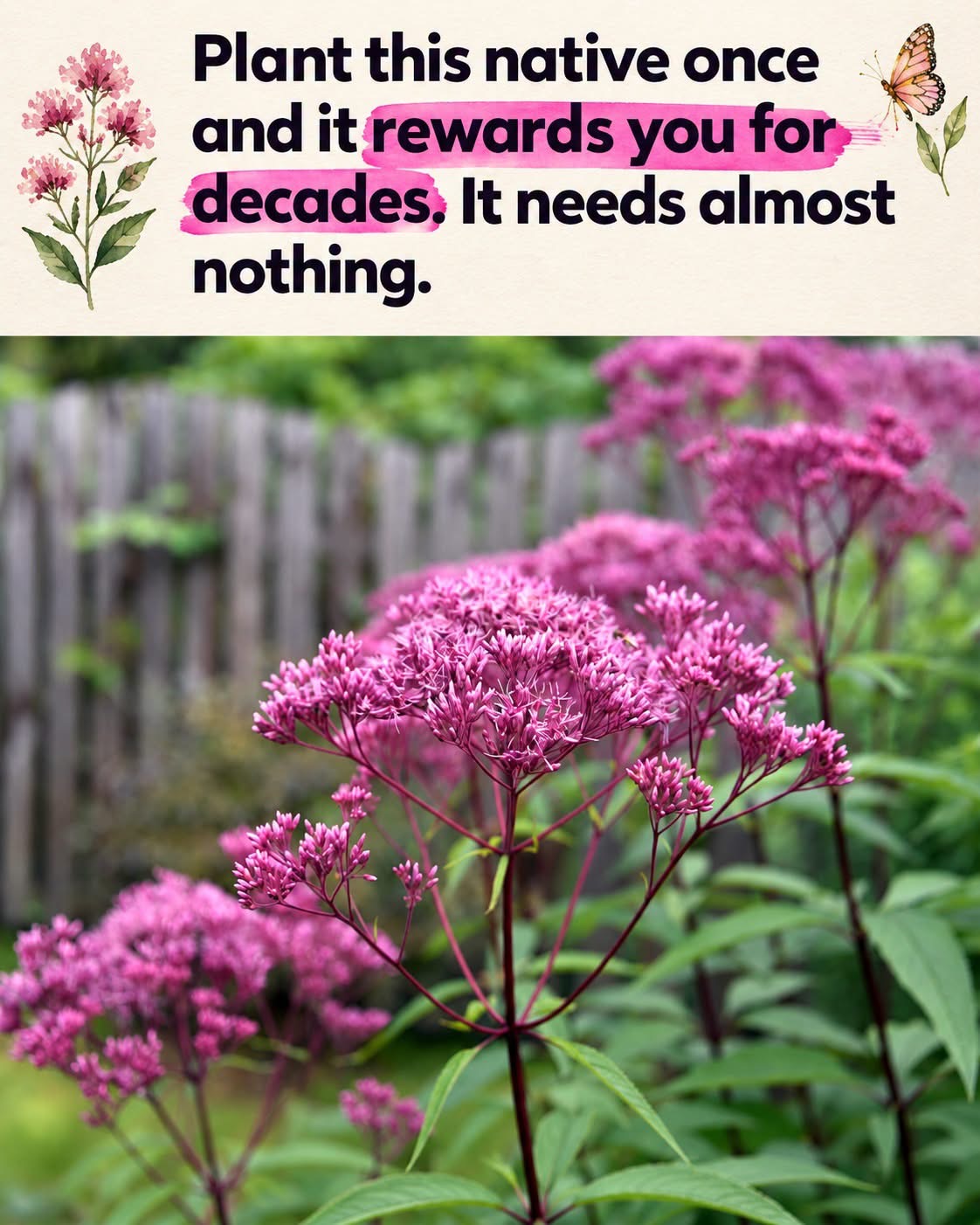
If you’ve ever seen a towering plant covered in clouds of pink or purple flowers and wondered what it was, there’s a good chance you were looking at Joe-Pye weed.
Despite the word “weed” in its name, Joe-Pye weed isn’t simply an unwanted plant. Several species in the genus Eutrochium are valuable native perennials that can bring height, late-season color and an impressive number of pollinators into the garden.
Joe-Pye weed is especially useful in native and pollinator gardens because its flowers attract bees, butterflies and other insects. Different species vary in size and growing conditions, but many prefer sunny locations and consistently moist soil. (Plant Toolbox)
Here are five reasons you may want to make room for this spectacular perennial.
What Is Joe-Pye Weed?
Joe-Pye weed is the common name used for several species of Eutrochium, a genus of herbaceous perennial plants in the daisy family.
One commonly grown species is Eutrochium purpureum, often called sweet Joe-Pye weed.
These plants are native to areas of eastern and central North America and naturally occur in places such as moist meadows, woodland edges, riverbanks and other areas where soil moisture is available. (Plant Toolbox)
Depending on the species, Joe-Pye weed can become quite large.
Some forms grow several feet tall, making them excellent choices for the back of a perennial border, meadow garden or naturalized planting.
1. Joe-Pye Weed Is a Pollinator Magnet
Perhaps the biggest reason to grow Joe-Pye weed is its wildlife value.
Its large flower clusters are made up of many tiny individual flowers that provide nectar for a variety of insects.
Bees and butterflies are frequent visitors, while other pollinating insects may also use the flowers.
North Carolina Extension specifically lists Joe-Pye weed as a plant that attracts bees, butterflies, skippers and moths. (Plant Toolbox)
Clemson Extension likewise describes Joe-Pye weed as highly attractive to butterflies and other beneficial insects. (Home & Garden Information Center)
That’s especially useful if you’re trying to create a garden that supports pollinators rather than simply producing flowers for decoration.
Why pollinators matter
A successful pollinator garden isn’t about planting one flower and expecting it to solve everything.
The best gardens provide a succession of flowers throughout the growing season.
Joe-Pye weed can become an important part of that sequence by providing flowers during the summer and into the later part of the season, depending on the species and location. (Penn State Extension)
2. It Provides Late-Season Color
One of the frustrating things about many gardens is what happens toward the end of summer.
Early-season flowers have finished.
Some summer perennials are fading.
The garden begins to look tired just when fall is approaching.
Joe-Pye weed can help fill that gap.
Penn State Extension lists Joe-Pye weed among native perennials that provide a late-season burst of color while feeding pollinators. (Penn State Extension)
The flowers are generally pink, mauve or purple depending on the species and cultivar.
The flower clusters can also become surprisingly large, creating a dramatic visual effect from a distance.
3. It’s a Beautiful Native Plant
Native plants have an important role in wildlife-friendly landscaping.
Joe-Pye weed is native to large portions of eastern and central North America, making appropriate native species and cultivars valuable additions to regional gardens. (Plant Toolbox)
N.C. Cooperative Extension specifically includes Joe-Pye weed among plants useful for supporting bees and other pollinators. (Forsyth County Center)
Instead of building a garden entirely around ornamental plants selected for appearance, you can combine attractive native plants with other garden favorites.
The result can be beautiful while also providing food and habitat for wildlife.
4. It’s Perfect for a Moist Garden Area
Have a section of your yard that always seems to stay wetter than the rest?
Joe-Pye weed may be worth considering.
Many Joe-Pye weed species perform best in moist, well-drained soil.
Some species tolerate occasionally wet conditions, while others naturally occur in wetter habitats. (Plant Toolbox)
This makes them particularly useful around:
- Rain gardens
- Pond edges
- Moist meadows
- Low areas of the landscape
- Streamside plantings
- Naturalized gardens
- Pollinator gardens
However, don’t assume every Joe-Pye weed species has exactly the same moisture requirements.
Check the requirements of the particular species or cultivar you’re purchasing.
5. It Makes a Dramatic Garden Focal Point
Joe-Pye weed isn’t a tiny plant that disappears among other flowers.
It’s a statement plant.
Depending on the species, mature plants can reach several feet tall and several feet wide. N.C. Extension lists Eutrochium purpureum at approximately 5–7 feet tall and 2–4 feet wide. (Plant Toolbox)
That makes it particularly useful toward the back of a garden border.
You can combine it with shorter plants in front to create several layers of height.
A simple planting design
Try combining:
Back: Joe-Pye weed
Middle: Medium-height native perennials
Front: Low-growing flowering plants
Ground level: Native grasses and groundcovers
This gives the garden depth while allowing Joe-Pye weed’s flowers to rise above the surrounding plants.
How to Grow Joe-Pye Weed
Growing Joe-Pye weed is relatively straightforward when you choose a suitable location.
Choose the Right Light
Joe-Pye weed generally performs well in full sun to partial shade.
However, insufficient light can cause tall plants to become leggy and more likely to fall over. (Plant Toolbox)
For the strongest growth and best flowering, choose a location with plenty of sunlight while considering the moisture requirements of your particular species.
Provide Moist, Well-Drained Soil
Moisture is one of the most important factors.
Joe-Pye weed generally prefers soil that stays moist rather than becoming completely dry.
At the same time, “moist” doesn’t necessarily mean permanently waterlogged.
Many species prefer moist but well-drained conditions. (Plant Toolbox)
If your garden soil dries out rapidly during summer, you may need to provide supplemental irrigation.
Give It Plenty of Space
This is one of the biggest mistakes new gardeners make.
A tiny plant purchased at a garden center may look harmless.
A mature Joe-Pye weed can be several feet tall and wide.
Before planting, check the mature dimensions of your particular species or cultivar.
Don’t place a large species directly in front of a window or squeeze it between small perennials.
Should You Cut Back Joe-Pye Weed?
Yes, but timing matters.
You can leave the dried stems and seed heads standing into winter if you want additional structure and wildlife value.
North Carolina Extension notes that the seed heads can persist into winter and that the plant can be cut back at the end of the season. (Plant Toolbox)
For a more compact plant, some Joe-Pye weed varieties can also be cut back earlier in the growing season.
Illinois Extension notes that pruning Joe-Pye weed in early June can produce a more compact plant. (Illinois Extension)
The exact timing depends on the species and your desired result.
Does Joe-Pye Weed Spread?
Joe-Pye weed is a clump-forming perennial, and some species can spread gradually through their root systems or reseed under suitable conditions.
It isn’t accurate to treat every Joe-Pye weed as an aggressive invasive plant.
Instead, consider its mature size and growth habit before planting.
If the clump eventually becomes too large, division is one way to manage it.
Cornell Extension notes that Joe-Pye weed can be divided in spring before substantial growth begins or in late fall. (blogs.cornell.edu)
How to Propagate Joe-Pye Weed
Joe-Pye weed can be propagated in several ways.
Division
Division is one of the easiest methods for established plants.
Dig up the clump during an appropriate dormant period and carefully divide the root system into sections containing viable roots and shoots.
Replant the divisions promptly and keep them adequately watered while they establish.
Stem Cuttings
Softwood or stem cuttings can also be used for propagation.
N.C. Extension lists stem cuttings as one propagation option, with late spring being an appropriate time for cuttings. (Plant Toolbox)
Seeds
Joe-Pye weed can also be grown from seed.
However, seed germination can be challenging for some species.
N.C. Extension notes that Eutrochium purpureum seeds require approximately three months of cold, moist stratification and that actual germination can be low. (Plant Toolbox)
For gardeners who simply want another plant, division may be easier.
Is Joe-Pye Weed Good for Butterflies?
Yes.
Joe-Pye weed is particularly useful in butterfly and pollinator gardens.
Its flowers provide nectar for butterflies and other adult insects, while its foliage can also serve as food for caterpillars of some moth species. (Plant Toolbox)
Missouri’s Department of Conservation lists numerous insects associated with Joe-Pye weeds, including several moth caterpillars. (mdc.mo.gov)
This is an important distinction when designing a wildlife garden.
A plant doesn’t have to attract butterflies every second to be valuable.
It can support different insects at different stages of their life cycles.
Is Joe-Pye Weed Deer Resistant?
Joe-Pye weed is considered relatively resistant to deer browsing in some extension resources, although no plant should be considered completely deer-proof.
Clemson and other extension resources identify Joe-Pye weed as relatively resistant to deer and rabbits. (dc.statelibrary.sc.gov)
If deer pressure is severe in your area, monitor the plant rather than assuming it will never be browsed.
Common Joe-Pye Weed Problems
Joe-Pye weed is generally considered a relatively low-maintenance perennial, but a few problems can occur.
Powdery Mildew
Powdery mildew can occasionally affect Joe-Pye weed.
Good air circulation and appropriate plant spacing can help reduce disease pressure.
Avoid creating an overcrowded planting where foliage remains damp for long periods.
Rust
Rust diseases can also occur.
Monitor the leaves for unusual spotting or discoloration and improve airflow where necessary.
Wilting or Scorched Leaves
If the soil becomes too dry, Joe-Pye weed can show stress.
This is particularly important during hot weather.
If your plant is wilting repeatedly, check the soil moisture and irrigation conditions.
Flopping Plants
Tall Joe-Pye weed can become floppy when growing conditions aren’t ideal.
Inadequate sunlight can contribute to weak, leggy growth. (Plant Toolbox)
Choosing an appropriate location and selecting a more compact cultivar can help.
Joe-Pye Weed vs. Other Pollinator Plants
Joe-Pye weed works particularly well as part of a diverse pollinator garden.
Don’t rely on it as your only nectar source.
Combine it with plants that bloom in spring, summer and fall.
For example, you could combine Joe-Pye weed with:
- Native milkweeds
- Goldenrod
- Mountain mint
- Asters
- Coneflowers
- Black-eyed Susans
- Native grasses
The goal is continuous bloom rather than one huge flowering event.
Why Every Pollinator Garden Needs More Than One Plant
A successful pollinator garden should provide resources across the entire growing season.
Penn State Extension recommends using a variety of plants that bloom at different times to support different pollinators. (Penn State Extension)
That means your garden might contain:
Spring flowers → early-season food
Summer flowers → peak pollinator activity
Late-summer and fall flowers → food when many other plants are finishing
Joe-Pye weed can play an important role in that final part of the season.
Frequently Asked Questions
Is Joe-Pye weed actually a weed?
Despite its common name, Joe-Pye weed is a desirable native perennial commonly grown in pollinator, native and naturalized gardens.
Does Joe-Pye weed attract bees?
Yes. Its flower clusters attract bees and numerous other pollinating insects. (Plant Toolbox)
Does Joe-Pye weed attract butterflies?
Yes. Butterflies frequently visit its nectar-rich flowers. (Home & Garden Information Center)
How tall does Joe-Pye weed get?
The answer depends on the species. Eutrochium purpureum can reach roughly 5–7 feet, while other Joe-Pye weed species can become even taller. (Plant Toolbox)
Does Joe-Pye weed like wet soil?
Many species prefer moist soil and tolerate occasionally wet conditions, but the exact requirements vary by species. (Plant Toolbox)
Does Joe-Pye weed need full sun?
Joe-Pye weed generally grows well in full sun to partial shade. More sunlight can help produce stronger growth and reduce legginess. (Plant Toolbox)
Can Joe-Pye weed grow in a small garden?
It can, but choose a compact cultivar and give it enough room. Traditional species can become very large.
When should Joe-Pye weed be cut back?
You can cut it back after the growing season, although leaving the seed heads standing through winter can provide garden structure and wildlife value. (Plant Toolbox)
Can you grow Joe-Pye weed from seed?
Yes, but germination may be difficult for some species. Cold, moist stratification may be necessary. (Plant Toolbox)
Final Thoughts
Joe-Pye weed may have an unfortunate name, but it is anything but an unwanted plant.
With tall stems, enormous flower clusters and a remarkable ability to attract pollinators, it can become one of the most impressive plants in a native or wildlife-friendly garden.
Its biggest drawback is also one of its biggest advantages: it gets large.
Give it enough space, provide the moisture it prefers, and plant it where its height won’t overwhelm smaller flowers.
In return, you’ll get a dramatic perennial that can bring color to the garden while providing valuable resources for bees, butterflies and other wildlife.
And the next time you see Joe-Pye weed, you might think twice before pulling it out.
It may be exactly what your garden needs.