
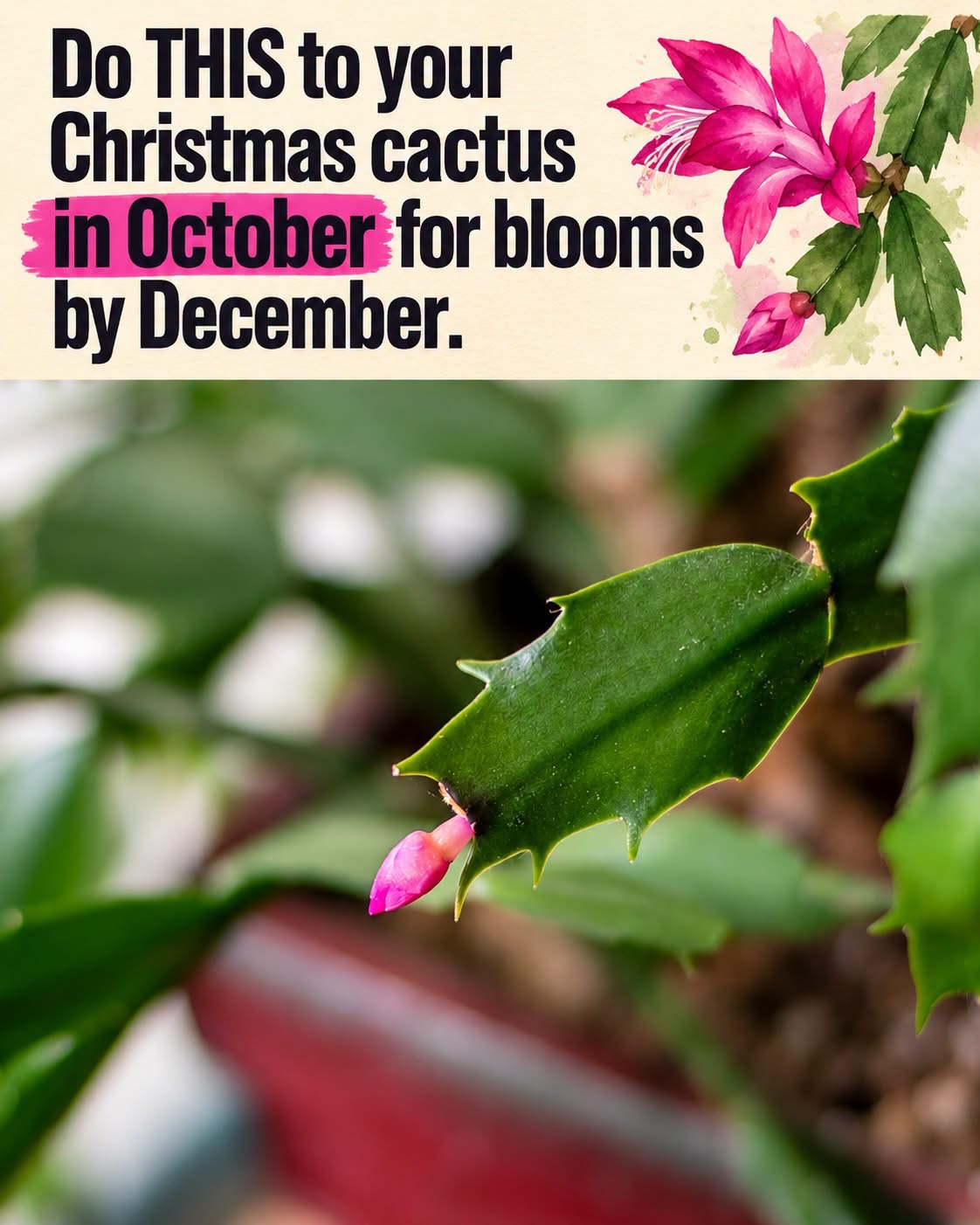
If you want your Christmas cactus covered in beautiful flowers during the holiday season, October is one of the most important months to pay attention to.
Christmas cactus and other holiday cacti don’t bloom simply because winter arrives. Their flowering is triggered by environmental signals, especially shorter days, longer uninterrupted nights and cooler temperatures.
In fact, university extension experts explain that holiday cacti are short-day plants and need specific light and temperature conditions to initiate flower buds.
So if your plant is healthy but rarely flowers, the problem may not be the plant at all.
It may simply be getting the wrong signals.
Why October Matters for Christmas Cactus
As summer ends, the days become shorter and nighttime temperatures begin to fall.
Those changes tell a holiday cactus that its growing season is winding down and that it’s time to prepare for flowering.
According to Rural Sprout, October is a particularly useful time to create these conditions if you want holiday blooms in December.
The process doesn’t happen overnight. Flower-bud development can take several weeks, which is why waiting until December to try to force flowers may be too late.
1. Give Your Christmas Cactus Longer, Darker Nights
This is probably the most important October step.
Christmas cactus is a short-day plant. That means it responds to longer periods of darkness as autumn progresses.
For many holiday cacti, approximately 12–14 hours of uninterrupted darkness each night can help initiate flowering. Some cultivars may require even longer dark periods.
The important word is uninterrupted.
A plant sitting in a dark room isn’t truly experiencing a long night if a bright lamp is switched on beside it every evening.
What should you do?
Choose a location where the plant can receive:
- Bright, filtered light during the day
- Long, uninterrupted darkness at night
- Minimal artificial light during its dark period
If your home stays bright late into the evening, you can place the plant somewhere naturally dark at night or use a breathable dark covering to block light.
The goal is to recreate the long autumn nights the plant would experience naturally.
2. Keep the Nights Cool
Light isn’t the only signal involved in flowering.
Temperature matters too.
University extension guidance commonly recommends cool nighttime temperatures in the range of roughly 55–65°F (13–18°C) during flower initiation.
Iowa State Extension also notes that temperatures above about 70°F can interfere with flowering, while cooler fall conditions can help trigger buds.
You don’t need to freeze your plant.
Instead, look for a naturally cooler room in your home.
A cool bedroom, enclosed porch or other protected location may work well as long as the plant isn’t exposed to frost, extreme cold or drafts.
3. Don’t Put It Directly Beside a Cold Window
Cool is helpful.
Sudden temperature changes are not.
Avoid placing your Christmas cactus directly against a freezing window or in a location where cold air constantly blows across it.
Holiday cacti can also drop flower buds when exposed to sudden environmental changes.
A stable, cool environment is much better than repeatedly moving the plant between warm and cold conditions.
4. Be More Careful With Watering in October
Holiday cacti aren’t desert cacti.
They naturally grow in humid, forest environments, so they don’t want to be kept bone dry for long periods.
However, they also don’t tolerate constantly soggy soil.
Overwatering can lead to root problems, and well-drained soil is essential.
As the plant’s growth slows in autumn, it generally uses less water.
That means you should pay more attention to the potting mix instead of watering automatically on a fixed schedule.
A simple rule:
Check the soil before watering.
If the upper portion has dried, water thoroughly and allow excess water to drain away.
Don’t allow the pot to sit in standing water.
5. Don’t Repot Your Christmas Cactus in October
October is generally not the time to repot a healthy Christmas cactus simply because the pot looks crowded.
Holiday cacti often flower well when slightly root-bound.
University of Vermont Extension notes that repotting is generally only necessary every few years, rather than annually.
If your plant is healthy and beginning its flowering cycle, leave it alone.
Avoid unnecessary disturbance.
6. Don’t Fertilize Heavily During Bud Formation
Fertilizing is useful during active growth, but October isn’t the time to push your plant into vigorous leafy growth.
University extension recommendations generally focus fertilizer applications during the active growing season and reducing or stopping feeding as the plant enters its flowering period.
The goal now is flower formation, not producing lots of new green growth.
7. Give It Bright Light During the Day
Darkness at night doesn’t mean your Christmas cactus should sit in a dark room all day.
During daylight hours, give it bright, indirect or filtered light.
Holiday cacti prefer bright filtered light and can suffer from excessive direct sunlight.
An area near a bright window with protection from harsh direct afternoon sun can work beautifully.
8. Don’t Interrupt the Dark Period
This is one of the easiest mistakes to make.
Imagine putting your plant in a dark room at 5 p.m., then switching on a bright light beside it at 9 p.m.
That interruption can interfere with the short-day signal.
UF/IFAS specifically recommends keeping holiday cacti away from artificial light at night from October through December when trying to encourage holiday flowering.
So don’t put the plant next to:
- A bright lamp
- A television that illuminates the room
- Strong overhead lighting
- A bright hallway
- Outdoor security lighting shining through a window
A dark, quiet location is ideal.
9. Once Buds Appear, Stop Fussing With the Plant
When you finally notice tiny flower buds forming at the ends of the segments, you’ve reached an important stage.
Now consistency matters.
Avoid suddenly changing the temperature, moving the plant to a completely different location or dramatically changing your watering routine.
Christmas cactus can experience bud drop because of environmental stress, including temperature changes, drafts and improper watering.
If possible, leave it where it is until the buds develop further.
How Long Does It Take for a Christmas Cactus to Bloom?
Flower initiation isn’t instantaneous.
Depending on the cultivar and growing conditions, holiday cacti generally need several weeks of appropriate short-day and cool-temperature conditions before flowers develop.
This is why starting in October can be so useful if you want flowers around the holidays.
UMN Extension reports that Christmas and Thanksgiving cacti can bloom after approximately six weeks of short days, while other extension sources give ranges of roughly four to eight weeks depending on conditions.
Christmas Cactus or Thanksgiving Cactus?
Here’s another reason your plant may not bloom exactly at Christmas.
You may not actually have a true Christmas cactus.
Many plants sold as Christmas cactus are actually Thanksgiving cactus (Schlumbergera truncata).
Thanksgiving cactus
Thanksgiving cactus generally has more pointed, claw-like projections along the edges of its segments.
True Christmas cactus
The true Christmas cactus, Schlumbergera × buckleyi, has more rounded, scalloped segment edges.
North Carolina State Extension identifies the true Christmas cactus as an epiphytic hybrid and notes its preference for bright indirect light, airy well-drained soil and cool nighttime conditions for flowering.
So if your plant blooms in November rather than December, it may not be doing anything wrong.
It may simply be a Thanksgiving cactus.
What If Your Christmas Cactus Has No Buds?
Don’t panic.
First check the environment.
Ask yourself:
- Is it receiving enough bright daytime light?
- Is it getting a sufficiently long uninterrupted night?
- Is artificial light reaching it after dark?
- Are nighttime temperatures too warm?
- Is the soil constantly wet?
- Have you recently moved the plant?
- Is it being exposed to drafts or sudden temperature changes?
- Did you fertilize heavily late in the season?
These are much more useful questions than simply asking whether your plant needs more fertilizer.
What If the Buds Fall Off?
Bud drop is frustrating, but it doesn’t necessarily mean your plant is dying.
Sudden environmental changes are one common reason holiday cactus buds drop.
Excessive heat, drafts, improper watering and low light can also contribute.
Try to keep the plant’s conditions stable.
Once buds have formed, don’t constantly move the plant around the house looking for a better display location.
Wait until the flowers are opening before moving it somewhere more visible.
Should You Cover a Christmas Cactus With a Pillowcase?
A dark covering can be useful if your home doesn’t naturally provide enough darkness.
The purpose isn’t to suffocate the plant.
The purpose is simply to prevent light from reaching it during its required dark period.
If you use a cover, make sure it doesn’t crush the plant, trap excessive heat or restrict airflow.
Alternatively, putting the plant in a naturally dark room can be easier.
Should You Put Your Christmas Cactus in a Closet?
A closet can work for creating darkness, but the plant still needs appropriate daytime light.
Don’t keep it locked in darkness around the clock.
A better routine is:
Day: bright, indirect light.
Night: complete darkness.
This mimics the natural change in day length that triggers flowering.
The October Christmas Cactus Routine
If you want a simple routine to follow, use this checklist:
During the day
Keep your Christmas cactus in bright, indirect or filtered light.
During the evening
Move it into a location where it won’t be exposed to artificial light, or cover it appropriately.
Overnight
Aim for a long, uninterrupted dark period.
Temperature
Keep nights cool, ideally around 55–65°F (13–18°C), while avoiding freezing conditions and harsh drafts.
Watering
Check the potting mix before watering. Don’t keep the roots constantly wet.
Fertilizer
Avoid pushing heavy growth during the flowering period. Resume appropriate feeding during the active growing season.
Repotting
Don’t repot a healthy plant unnecessarily in October.
Once buds appear
Keep conditions stable and avoid unnecessary movement.
Can You Still Get Blooms If You Didn’t Start in October?
Possibly.
Don’t throw your plant away just because October has already passed.
Flowering depends on the plant, cultivar, temperature, light exposure and overall health.
If you start providing appropriate conditions later, your plant may still flower, although the timing may not match your desired holiday date.
The best strategy is to start preparing early next year.
Final Thoughts
Getting a Christmas cactus to bloom isn’t really about finding a magical fertilizer or watering trick.
It’s about understanding what the plant is responding to.
As autumn arrives, shorter days, longer uninterrupted nights and cooler temperatures tell holiday cacti that it’s time to begin preparing for flowers.
October is therefore an excellent time to check your plant’s environment.
Give it bright daytime light, cool and stable nights, a long uninterrupted dark period, careful watering and minimal disturbance.
Do that consistently, and those tiny green buds may soon turn into the spectacular flowers you’ve been waiting for all year.
And if your “Christmas cactus” blooms around Thanksgiving instead?
Don’t worry.
You may simply have one of the incredibly common Thanksgiving cacti.
Either way, a Schlumbergera covered in flowers is a beautiful holiday tradition worth keeping.