
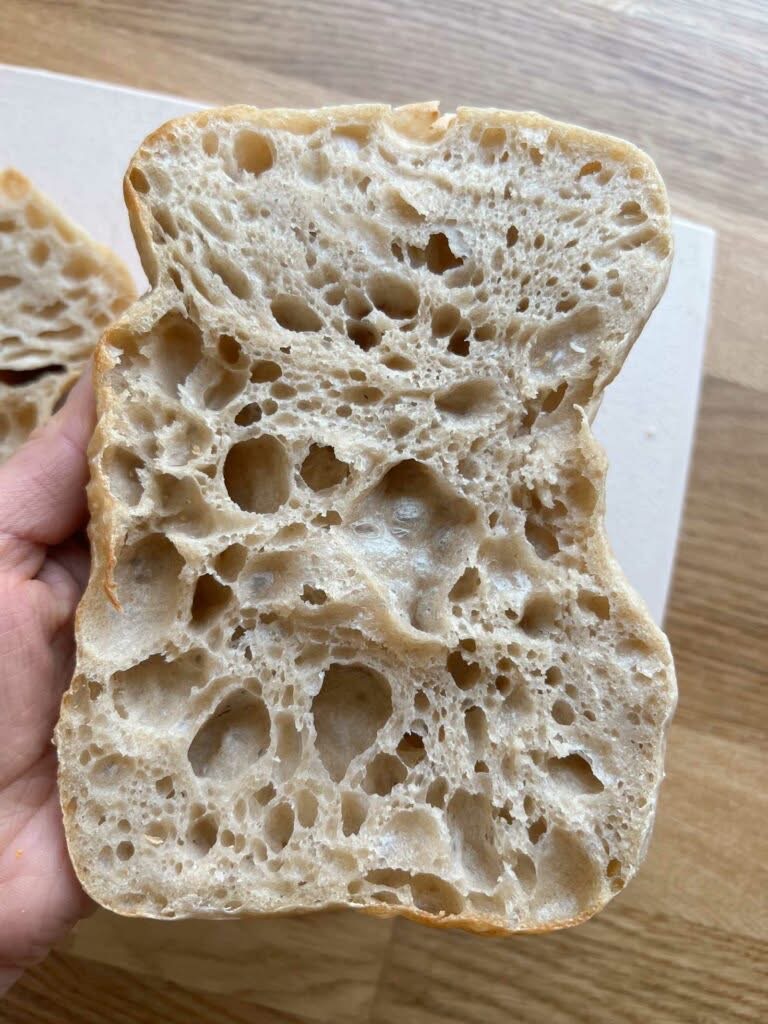
Artisan Ciabatta Bread Recipe (Open Crumb & Large Holes)
Create bakery-quality ciabatta bread with a light, airy texture and beautiful open crumb. This high-hydration dough develops exceptional flavor and structure through a long fermentation, producing the signature irregular holes found in authentic Italian ciabatta.
Why You’ll Love This Recipe
- Large, open crumb structure
- Crispy golden crust
- Minimal kneading required
- Deep, complex flavor
- Perfect for sandwiches, dipping oils, and bruschetta
- Beginner-friendly with step-by-step instructions
What Makes Ciabatta Different?
Ciabatta is an Italian bread known for its high water content and rustic appearance. The wet dough creates steam during baking, allowing large air pockets to develop inside the loaf. Combined with gentle handling and proper fermentation, this produces the beautiful honeycomb-like crumb seen in artisan bakeries.
Ingredients
Dough
- 500g bread flour (100%)
- 400g water, room temperature (80% hydration)
- 10g sea salt (2%)
- 2g instant yeast (0.4%)
- 10g olive oil (optional)
For Dusting
- Rice flour or bread flour
Equipment
- Large mixing bowl
- Dough scraper
- Kitchen scale
- Baking stone or steel (recommended)
- Parchment paper
- Spray bottle with water
Baker’s Percentages
| Ingredient | Percentage |
| Bread Flour | 100% |
| Water | 80% |
| Salt | 2% |
| Yeast | 0.4% |
Step 1: Mix the Dough
- Add flour and water to a large bowl.
- Mix until no dry flour remains.
- Cover and let rest for 30 minutes (autolyse).
- Add yeast and salt.
- Mix thoroughly until incorporated.
- Add olive oil if using.
The dough will be sticky and shaggy. This is normal and essential for an open crumb.
Step 2: Bulk Fermentation
Cover the bowl and ferment at room temperature for 3–4 hours.
During the first 2 hours, perform 4 sets of stretch-and-folds:
Fold Schedule
- 30 minutes: First fold
- 60 minutes: Second fold
- 90 minutes: Third fold
- 120 minutes: Fourth fold
To stretch and fold:
- Wet your hands.
- Grab one side of the dough.
- Stretch upward.
- Fold over the center.
- Rotate bowl and repeat 4 times.
Each fold strengthens gluten without traditional kneading.
Step 3: Cold Fermentation
For the best flavor and crumb:
- Cover the dough tightly.
- Refrigerate 12–18 hours.
This slow fermentation develops complexity and improves structure.
Step 4: Shape the Dough
- Generously flour your work surface.
- Carefully turn out the dough.
- Avoid pressing out the gas.
- Gently stretch into a rectangle.
- Divide into 2 ciabatta loaves if desired.
The goal is to preserve as many air bubbles as possible.
Step 5: Final Proof
- Transfer dough to a floured couche or parchment paper.
- Dust lightly with flour.
- Cover loosely.
- Proof for 45–60 minutes.
The dough should become puffy but not collapse.
Step 6: Bake
Oven Setup
Preheat oven to:
- 250°C (480°F)
- At least 45 minutes before baking
Place a baking stone or steel inside if available.
Baking Process
- Transfer dough carefully to hot stone.
- Add steam during first 10 minutes.
- Bake at 250°C (480°F) for 10 minutes.
- Reduce to 230°C (445°F).
- Continue baking 15–20 minutes.
Internal Temperature
Bread is fully baked at:
- 96–99°C (205–210°F)
The crust should be deeply golden brown.
Cooling
Allow bread to cool completely for at least 1 hour before slicing.
Cutting too early can compress the crumb and make the interior gummy.
Tips for Large Open Holes
Use Strong Flour
Bread flour with 12–14% protein helps create strong gluten networks.
Keep Hydration High
80% hydration produces the large holes typical of artisan ciabatta.
Handle Gently
Avoid excessive degassing during shaping.
Don’t Add Too Much Flour
Extra flour can tighten the crumb and reduce openness.
Ferment Properly
Underproofed dough produces dense bread, while overproofed dough collapses.
Troubleshooting
Dense Crumb
Possible causes:
- Underproofing
- Weak gluten development
- Low hydration
- Too much flour during shaping
Large Holes Only at the Top
Possible causes:
- Underfermentation
- Insufficient folding
- Poor shaping technique
Flat Loaf
Possible causes:
- Overproofing
- Weak flour
- Excessive handling
Storage
- Room temperature: 2–3 days
- Freeze: Up to 3 months
- Reheat at 180°C (350°F) for 5–8 minutes to refresh crust
Frequently Asked Questions
Can I make ciabatta without a stand mixer?
Yes. Stretch-and-fold techniques develop enough gluten without mechanical mixing.
Why is the dough so sticky?
High hydration is necessary for the airy structure and open crumb.
Can I use all-purpose flour?
Yes, but bread flour produces a stronger structure and larger holes.
How do I get bakery-style open crumb?
Use high hydration, gentle handling, strong flour, and a long cold fermentation.
Final Result
This artisan ciabatta recipe produces a loaf with:
- Thin crispy crust
- Moist chewy interior
- Large irregular holes
- Rich fermented flavor
- Professional bakery appearance